AQA Chemistry Paper 1 2019 Mark Scheme: Complete Guide to Answers, Examiner Expectations, and Higher Grades

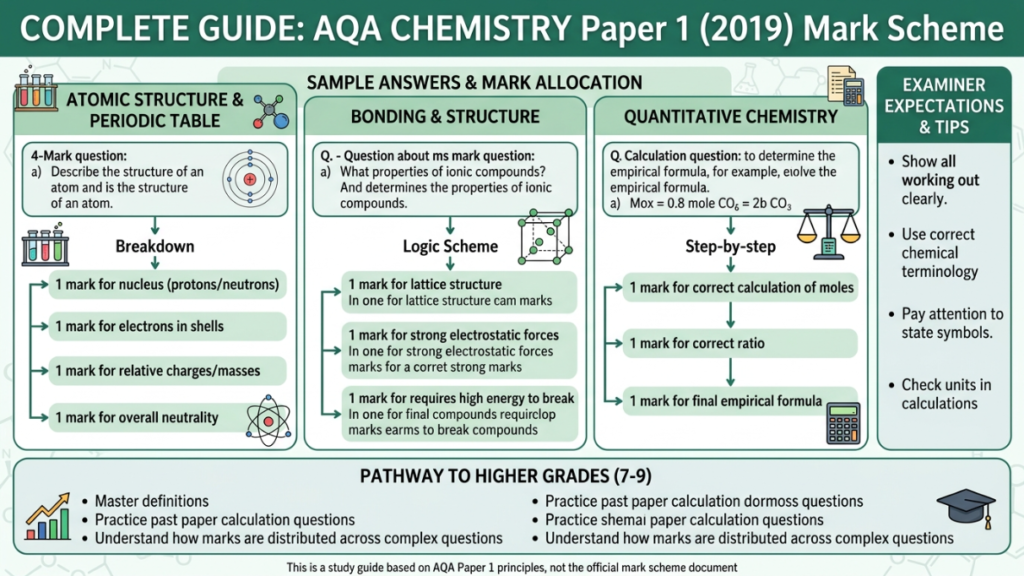
Preparing for GCSE Chemistry can feel overwhelming, especially when students are unsure how examiners award marks. The aqa chemistry paper 1 2019 mark scheme is one of the most valuable revision resources because it reveals exactly how answers are assessed, what examiners expect, and why certain responses earn full marks while others lose valuable points.
Whether you’re revising independently, working with a tutor, or preparing students in the classroom, understanding the aqa chemistry paper 1 2019 mark scheme provides insights that go far beyond checking correct answers. It teaches exam technique, highlights common mistakes, and helps develop the precision needed for success in AQA GCSE Chemistry.
Why the AQA Chemistry Paper 1 2019 Mark Scheme Matters
The aqa chemistry paper 1 2019 mark scheme is much more than an answer sheet. It explains how marks are distributed across calculation questions, practical investigations, extended responses, and multiple-choice sections, giving students a clearer understanding of assessment standards.
Instead of memorizing model answers, learners can identify the scientific vocabulary, logical reasoning, and calculations that examiners reward. This approach strengthens subject knowledge while improving confidence before future examinations.
Understanding How Marks Are Awarded
Every question within the aqa chemistry paper 1 2019 mark scheme follows carefully defined marking principles. Examiners are trained to award marks consistently, even when students phrase answers differently, provided the scientific meaning remains accurate.
Students often assume only one wording is acceptable, but many questions accept alternative valid responses. The mark scheme clearly identifies acceptable terminology, common alternatives, and situations where marks cannot be awarded because essential scientific concepts are missing.
Topics Covered in Paper 1
Paper 1 focuses on the foundation of GCSE Chemistry. Students encounter questions covering atomic structure, the periodic table, bonding, quantitative chemistry, chemical changes, energy changes, and required practical investigations.
Using the aqa chemistry paper 1 2019 mark scheme alongside these topics allows learners to understand not only the correct scientific principles but also the depth of explanation required to secure maximum marks in each assessment objective.
Key Features of the Official Mark Scheme
One of the greatest strengths of the aqa chemistry paper 1 2019 mark scheme is its detailed annotations. These explain acceptable answers, partial credit opportunities, and reasons why specific responses receive no marks.
The document also distinguishes between mandatory scientific terminology and optional wording. This helps students avoid losing marks due to vague language while encouraging more accurate scientific communication throughout their revision.
Breakdown of Assessment Areas
The table below summarizes how different question types are typically evaluated and what students should focus on during revision.
| Assessment Area | Examiner Focus | Common Student Mistake | Improvement Strategy |
|---|---|---|---|
| Multiple Choice | Accurate scientific knowledge | Misreading options | Read every option carefully before selecting |
| Calculations | Correct method and units | Missing working | Show every calculation step |
| Practical Questions | Scientific reasoning | Ignoring variables | Reference methods and observations clearly |
| Extended Responses | Logical explanations | Limited detail | Develop complete scientific arguments |
| Chemical Equations | Balanced equations | Incorrect symbols | Check formulas before balancing |
| Graph Interpretation | Data analysis | Ignoring trends | Describe patterns before concluding |
Understanding these assessment categories makes the aqa chemistry paper 1 2019 mark scheme significantly more useful than simply reviewing correct answers after completing a practice paper.
Common Mistakes Students Make
Many students lose marks not because they misunderstand chemistry but because they overlook small details. Missing units, incomplete calculations, inaccurate terminology, and vague explanations frequently reduce scores despite otherwise correct understanding.
Reviewing the aqa chemistry paper 1 2019 mark scheme reveals these recurring patterns. Once students recognize these pitfalls, they become much better at avoiding preventable mistakes during future examinations.
How to Use the Mark Scheme Effectively
The most productive revision method begins by completing the examination under timed conditions without assistance. Afterwards, compare every response against the mark scheme rather than simply checking whether an answer appears correct.
Students should rewrite incorrect responses using examiner-approved language. Repeating this process across multiple past papers gradually improves accuracy, scientific vocabulary, and confidence under exam conditions while making revision considerably more effective.
Examiner Expectations Explained
AQA examiners look for evidence that students understand chemistry rather than merely recalling isolated facts. Strong answers explain scientific processes clearly, include relevant terminology, and apply knowledge directly to the question being asked.
As educational expert Benjamin Franklin famously said, “An investment in knowledge pays the best interest.” This idea reflects effective exam preparation, where understanding the reasoning behind marks leads to stronger long-term performance than simple memorization.
Practical Questions and Required Experiments
Required practical investigations play an important role within GCSE Chemistry assessments. Students must understand procedures, identify variables, interpret results, and evaluate experimental methods using appropriate scientific language.
The aqa chemistry paper 1 2019 mark scheme demonstrates exactly how practical skills are assessed. By studying examiner comments, learners gain valuable insight into the level of detail expected when discussing laboratory investigations.
Improving Exam Technique Using Past Papers
Past papers become significantly more valuable when paired with detailed marking guidance. Instead of simply identifying incorrect answers, students learn why marks were lost and how stronger responses could have earned full credit.
Regular review of the aqa chemistry paper 1 2019 mark scheme transforms revision into active learning. This encourages critical thinking, improves written communication, and develops examination strategies that transfer effectively to future AQA assessments.
Benefits for Teachers, Tutors, and Parents
Teachers frequently use official mark schemes to demonstrate assessment standards during classroom feedback sessions. Tutors also rely on them when providing structured guidance because they reflect authentic examiner expectations rather than personal opinions.
Parents supporting revision at home can use the aqa chemistry paper 1 2019 mark scheme to understand how GCSE Chemistry is assessed. This creates more meaningful conversations about progress while helping students focus on genuine areas for improvement.
Building Long-Term Chemistry Success
Success in GCSE Chemistry depends on consistent practice, careful analysis, and learning from previous assessments. Students who regularly review examiner guidance develop stronger analytical skills and become increasingly confident with unfamiliar questions.
Rather than treating past papers as one-time exercises, learners should revisit them throughout revision. Combined with careful study of the aqa chemistry paper 1 2019 mark scheme, this strategy builds deeper scientific understanding and prepares students for both examinations and future science studies.
Conclusion
The aqa chemistry paper 1 2019 mark scheme remains one of the most valuable revision resources available for GCSE Chemistry students. It provides far more than correct answers by explaining examiner expectations, clarifying assessment criteria, and demonstrating how marks are awarded across every question type.
Students who study the mark scheme carefully gain practical advantages that extend beyond one examination. Better scientific vocabulary, stronger exam technique, improved confidence, and a deeper understanding of assessment standards all contribute to higher achievement. When combined with regular practice papers and focused revision, the aqa chemistry paper 1 2019 mark scheme becomes an essential tool for maximizing GCSE Chemistry success.
FAQ
What is the AQA Chemistry Paper 1 2019 mark scheme?
The aqa chemistry paper 1 2019 mark scheme is the official examiner guidance that explains how marks are awarded for every question in the 2019 GCSE Chemistry Paper 1 examination.
Why should students study the AQA Chemistry Paper 1 2019 mark scheme?
It helps students understand examiner expectations, identify common mistakes, improve scientific vocabulary, and learn how to earn full marks through accurate answers.
Can the AQA Chemistry Paper 1 2019 mark scheme improve exam performance?
Yes. Reviewing the aqa chemistry paper 1 2019 mark scheme alongside completed past papers helps students recognize weaknesses and develop stronger examination techniques.
Is the AQA Chemistry Paper 1 2019 mark scheme useful for teachers?
Absolutely. Teachers and tutors use it to provide accurate feedback, explain assessment criteria, and demonstrate the level of detail expected in GCSE Chemistry responses.
Should students memorize the AQA Chemistry Paper 1 2019 mark scheme?
No. Students should understand the reasoning behind the awarded marks rather than memorizing model answers. This approach develops transferable scientific knowledge and stronger exam skills.
Read More: https://blogpilot.co.uk/activity-2-1-2-student-response-sheet-answers/